
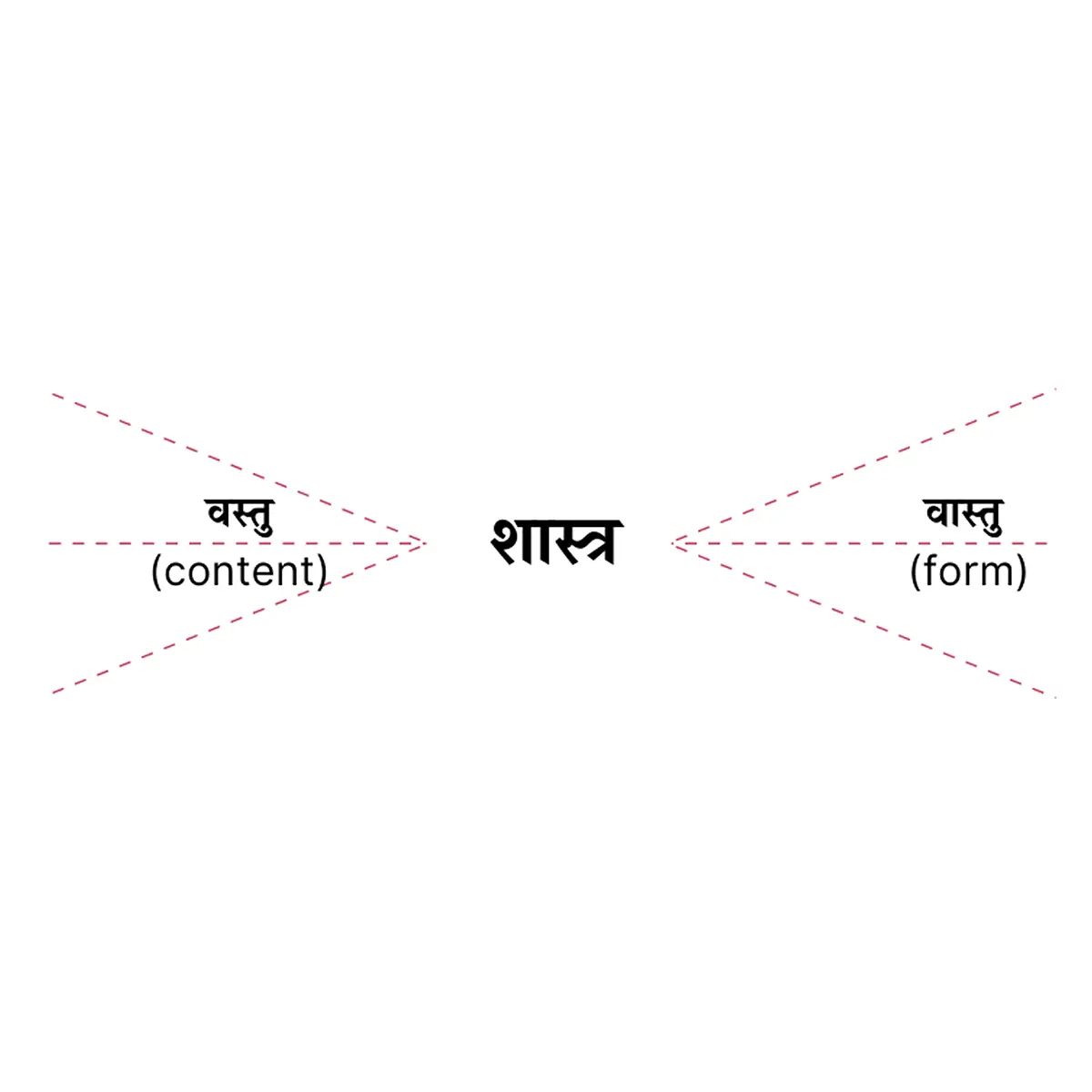
Vastu and Vāstu: why content and form must both come from the śāstras
To establish IKS as a universal episteme, we cannot borrow Western form to carry Indian content. Both वस्तु and वास्तु must emerge from within our own knowledge traditions.
Indic traditions historically have had their own unique thought processes and methods of elucidation and testing. Additionally, विद्या is conceptualized in Indian traditions not just as a tool to fulfill one’s material needs but as knowledge that helps human beings utilize their utmost capacities and respond to their higher needs. Within an Indic conception, human beings, as entities, are required to act as पुरुष:, who are aware of their पुरुषार्थ:।
Any knowledge conceptualized within IKS has to express the puruṣārtha model (पुरुषार्थ-प्रधानो विचार:)
धर्म: - order, principles अर्थ:- wealth, means काम:- objects, desire मोक्ष:- perfection, completeness
Also, knowledge conceptualized within the IKS should necessarily have ethical and moral dimensions, which helps human beings become self-organized and self-ordered. (विद्या भवति आत्मसंस्कारार्थ।). When विद्या (knowledge) is mixed with the unique experience of an individual, it transforms into दर्शनम (मनस्संस्कारर्थ दर्शनम उपेक्षितम।). It is the combination of विद्या and दर्शनम, that give rise to a new शास्त्रम।
Once established as such, the task of any śāstra within the knowledge system would be to identify the properties of objects being studied, explain their relationships, test them, and establish them in an organized manner. (शास्त्रेण कार्यकारणभाव: (साध्य-साधनभाव: प्रदश्यर्ते।)
Once established as such, the task of any śāstra within the knowledge system would be to identify the properties of objects being studied, explain their relationships, test them, and establish them in an organized manner. (शास्त्रेण कार्यकारणभाव: (साध्य-साधनभाव: प्रदश्यर्ते।)
Hence, within the IKS framework, various disciplines have to perform the following tasks; (i) abstraction of canon properties in diverse objects, (ii) classification by grasping special features in common objects
Everywhere, IKS-inspired disciplines need to follow the logic inherent in our Vedas;
“Always logic is considered to be (like) the light for all the vidyās, a means for (efficient performance) of all actions, (and) as supporters of all dharmas.”
प्रदीप सर्वविद्यानाम उपाय सर्वकर्मणाम। आश्रय सर्वधर्माणमां शश्वद आन्वीक्षिकी मता।।